
From Pixelated Pioneers to Modern Marvels: My Journey Through Gaming's Evolution
Explore the legacy and evolution of video games, from classic CRPGs like Fallout to modern successors such as UnderRail, Path of Exile, and Story of Seasons.
Sitting at my desk in 2026, surrounded by the soft glow of monitors and the familiar hum of cooling fans, I often find myself reflecting on the incredible journey video games have taken. It's a medium that has grown from bleeps and bloops into sprawling, immersive worlds, yet its history is sometimes a fragile thing. The games that defined genres and inspired generations can feel lost to time, trapped behind clunky interfaces or on hardware long since retired. But the beautiful thing about this art form is its ability to reinvent and reimagine. The spirit of those pioneering titles lives on, not just in memory, but in a new generation of games that capture that same magic for players like me today.
My adventure into this legacy often starts in the wasteland. I remember booting up the original Fallout for the first time, expecting something akin to the 3D adventures of later years. What I found was a different beast entirely: a harsh, isometric world of turn-based tactics and unforgiving choices. It was brilliant, but undeniably of its time. Then I discovered UnderRail. 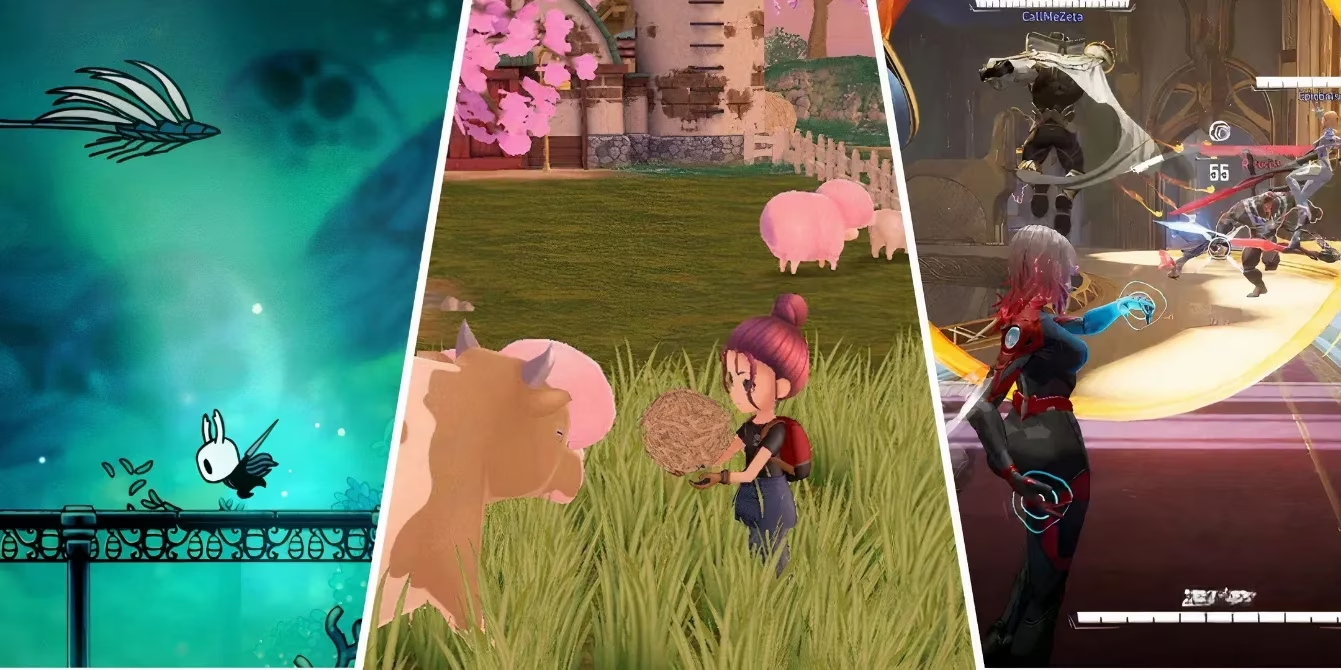 This modern CRPG didn't just emulate that old-school feel; it embraced it and built upon it. The deep character customization, the freedom to make catastrophic (and hilarious) mistakes, the pervasive atmosphere of bleak humor—it all felt like a direct conversation with those classic Interplay titles. Playing UnderRail was like finding a long-lost sequel that understood the assignment perfectly: be ruthless, be clever, and let the player write their own tragedy.
Of course, the dungeon crawl is another sacred pillar. The click-clack rhythm of Diablo 2 is etched into my muscle memory. When its successor arrived and shifted the feel so dramatically, a part of my gaming heart felt orphaned. That void, however, was spectacularly filled by Path of Exile. Grinding Gear Games didn't just make a spiritual successor; they built a monument to complexity and dark atmosphere. Its skill gem system offered a depth of customization that felt like a natural evolution of Diablo 2's talent trees, and its player-driven economy brought back that sense of a living, breathing (if damned) world. It proved that the core appeal of those classic ARPGs—the endless hunt for loot in a grim world—was timeless.
Not all my nostalgic journeys are through dark corridors, though. Sometimes, I just want to tend to my crops and befriend a town. The original Harvest Moon games were my comfort food. So, you can imagine my confusion a few years back when new "Harvest Moon" titles felt... off. The cozy magic was gone. The revelation was a relief: the soul of the series I loved had simply moved under a new name. Story of Seasons is that soul. It's the true continuation of Bokujo Monogatari, carrying forward all the charm, the gentle pacing, and the heartfelt connections that made the originals so special. It’s a perfect example of how a game's essence can transcend its name.
My exploration took a more solitary turn when I descended into the forgotten kingdom of Hallownest. Hollow Knight is more than a game; it's a masterclass in atmospheric world-building. As a huge fan of the Metroid series and the entire 'Metroidvania' genre it helped spawn, I've seen many attempts to capture that feeling of isolated exploration and gradual empowerment. Hollow Knight didn't just capture it; it perfected it. The sprawling, interconnected map, the weighty and precise combat, the haunting beauty of its insectoid world—it all felt like the natural next step for the genre. While Samus Aran explored alien planets, the Knight explores a dying civilization, and both journeys are powered by the same thrilling sense of discovery.
For a change of pace, I love the grand strategic thinking of turn-based conquest. Heroes of Might & Magic III defined my childhood weekends with its perfect blend of empire management and tactical battles. Finding a worthy successor felt like a quest in itself. Enter Songs of Conquest. This game is a love letter to that classic formula, modernized with stunning pixel art and a symphonic score that makes every decision feel epic. It retains the dual-layer gameplay I adore—building my forces on the overworld and then testing them in intricate combat—while introducing its own clever twists, like a spellcasting system deeply tied to my units. It feels both comfortingly familiar and excitingly new.
Then there are the games that ask you to fill in the blanks with your imagination. The original Rogue, with its ASCII graphics, was a testament to gameplay depth over visual fidelity. Its legacy is the entire 'roguelike' genre, but few modern games capture its sheer, simulated possibility. Caves of Qud is a glorious exception. It is bewildering, complex, and utterly magnificent. It trades Rogue's dungeon for a vast, open, and deeply simulated world where every creature has a lineage, every decision ripples outward, and your goals are your own to define. It's arguably less accessible than its predecessor, but for those willing to learn its language, it offers an unparalleled sense of freedom and emergent storytelling.
Finally, my journey brings me to the chaotic, team-based fun of the shooter. It's hard to imagine now, but there was a time before class-based hero shooters dominated the landscape. Team Fortress, starting as a Quake mod, laid the groundwork. Team Fortress 2 then polished that formula into something iconic and endlessly replayable. While TF2's servers are still wonderfully active, the genre has evolved. In 2026, Marvel Rivals stands out as a vibrant, modern incarnation of that team-based, ability-driven chaos. It takes the core concept of distinct roles and personalities clashing in objective-based matches and injects it with the kinetic energy and iconic heroes of the Marvel universe. It feels like the next chapter in a lineage that started with a simple mod.
Looking back, my gaming library in 2026 is a tapestry woven from threads of the past. These modern counterparts aren't mere replacements; they are conversations across decades. They answer the question: "What if that classic idea had today's technology and design philosophy?" They prove that while graphics age and interfaces evolve, the core joys of exploration, strategy, customization, and camaraderie are eternal. The pioneers may rest, but their spirit is very much alive, fighting new battles in new wastelands, farming new fields, and exploring new, beautifully haunting depths.
Leave a Comment