
Marvel Rivals’ Grandmaster Inflates: A 2026 Retrospective on Rank Distribution Chaos
Marvel Rivals ranked ladder faces scrutiny as Grandmaster rank swells, undermining competitive integrity and matchmaking quality.
Back in early 2025, the competitive landscape of Marvel Rivals was thrown into heated debate. Players everywhere were raising eyebrows at the strange behavior of its ranked ladder, and the conversation has only become more fascinating when viewed through the lens of 2026. At the heart of the turmoil was a simple question: had the climb up the ranks become far too easy? A graph shared by Redditor TheMadHa7, pulled from RivalsTracker, revealed that over 10 percent of 485,300 analyzed players sat comfortably in Grandmaster. For a tier intended to host the gatekeepers of elite play, that number was staggering—and it hinted at something deeply broken.
The Grandmaster rank was quickly turning into what Platinum used to be: a vast melting pot of skill levels rather than an exclusive club. The data showed Grandmaster 3 alone holding 26,640 players, edging past Diamond 3 at 25,459 and even Platinum 3 at 26,062. Margins paper-thin between three different ranks signaled that the skill differential among them had effectively collapsed. Climbing through the metal ranks and into the upper echelons had lost its meaning, because a player could simply grind their way upward without a positive win rate. Chrono-charged persistence, not mastery, was fueling progression. The numbers dipped only in the uppermost slices of Grandmaster and into Eternity, where the real elite still carved out a separate space, but for everyone else the prestige had evaporated.
To understand just how unusual this was, many fans pointed toward Overwatch 2. During Season 12 of Blizzard’s hero shooter, user Bullxbull compiled a rank distribution that displayed a textbook bell curve. The majority of players clustered around Gold, with ranks tapering off symmetrically on either side. That clean distribution reflected a system where climbing demanded consistent outperformance. Marvel Rivals, however, had somehow allowed a rank that should be in the upper tail of the curve to swell like a balloon. The shape was not a curve at all—it was a skewed spike, top-heavy and wobbly. Observers noted that this undermined competitive integrity: when a rank like Grandmaster acts more like a participation trophy, matchmaking quality crumbles.
The consequences rippled through every corner of the community. High-level players who actually deserved Grandmaster or above found themselves matched with allies and opponents whose fundamentals were shaky. Lower-skilled players, in turn, were thrust into lobbies far beyond their comfort zone, leading to frustration, toxicity, and a death spiral for match quality. Even those who ignored the competitive mode entirely could feel the side effects, as casual queues filled with escapees from the ranked mess. Earlier in the year, NetEase had toyed with a mid-season rank reset, only to backtrack after an outcry from players worried about wasted grind. But with this distribution laid bare, many started to admit that a reset—or something even more drastic—might have been exactly what the game needed.
Calls for change soon dominated social channels. A complete rework of the ranked system topped the wishlist. Suggestions ranged from proper placement matches to harsh decay mechanics, from stricter MMR thresholds to rank floors that actually required winning streaks to breach. The community’s sentiment was no longer about protecting the casual climb; it was about rescuing the soul of competition. NetEase had already shown they were willing to listen—they had reversed the reset decision swiftly—so hope brewed that Season 2 would bring a cooked-up solution.
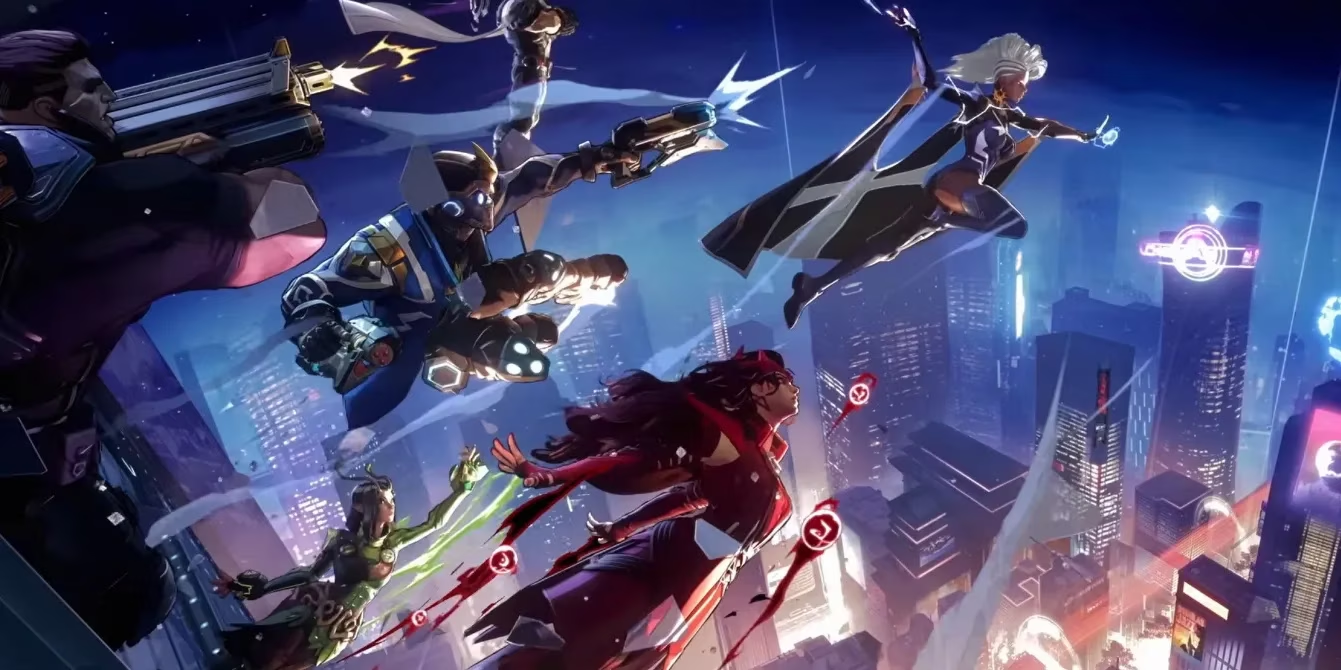
Looking back from 2026, that chapter feels like a turning point in the game’s lifecycle. While the exact tweaks that followed are now part of the title’s history, the episode underscored a universal truth about live-service competitive titles: accessibility must be balanced with merit, or the ladder becomes a ladder in name only. The Grandmaster hemorrhage of 2025 served as a cautionary tale, one that developers across the industry studied intently. For Marvel Rivals, it was proof that a community’s voice, paired with transparent statistics, could reshape the very structure of a game’s ranked identity. The heroes leaping through that skyscraper window may have been making an escape, but for NetEase, it was a moment to jump toward a more meaningful competitive future.
Leave a Comment